Our Projects
Xervices
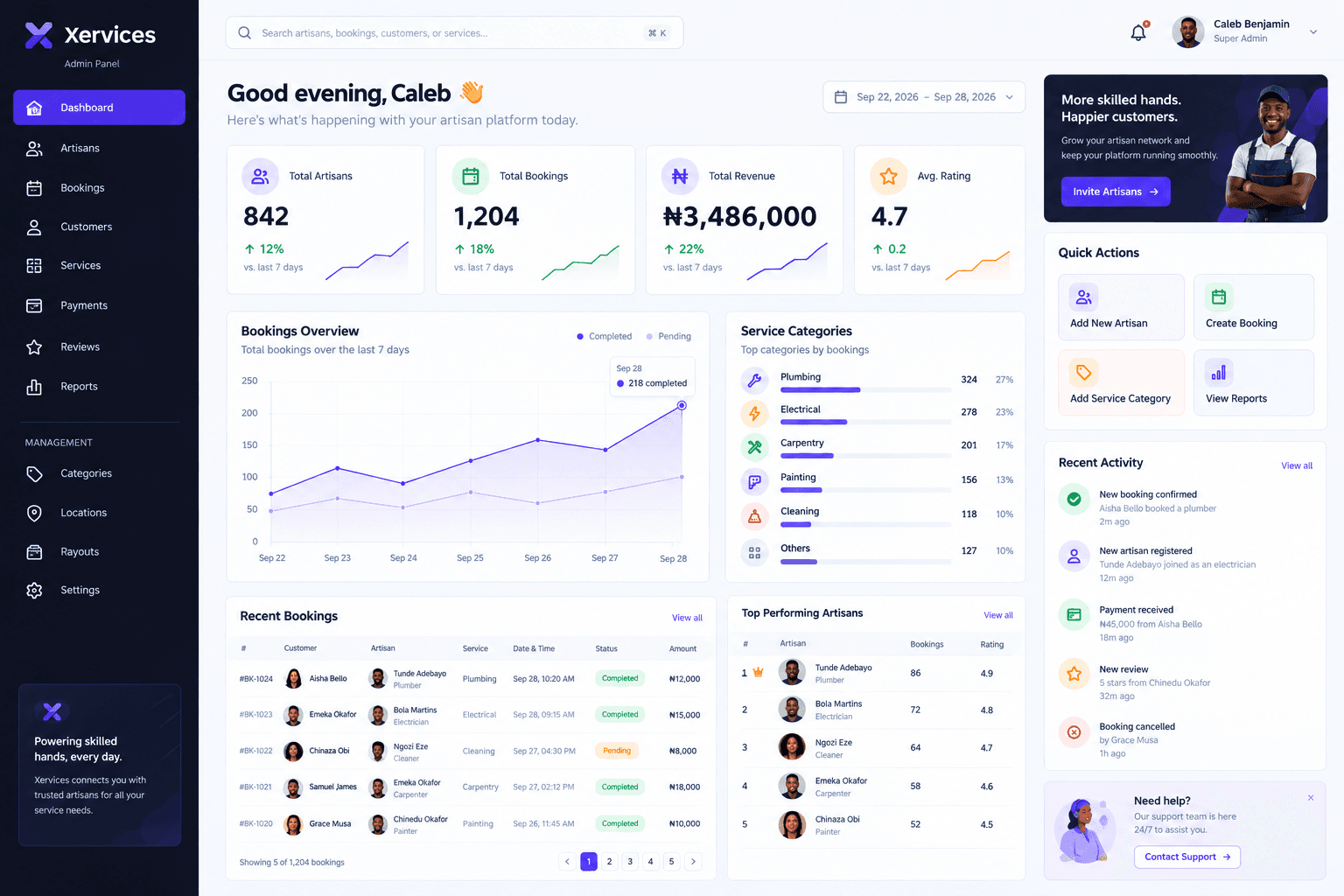
A location-based service marketplace connecting customers with vetted artisans — real-time job matching and bidding, escrow payments, live tracking, and KYC identity verification, built across four coordinated codebases.
“They understood that trust was the product, not a feature we could bolt on later.”
4
Independent codebases shipped
2
Native mobile apps
BVN + NIN
Identity verification
Client
Xervices
Categories
Full-Stack Product Engineering
Date
2025
Timeline
16 Weeks
The Idea
Xervices came to us with more than an idea, they had a precise read on what trust actually requires in a market where strangers do skilled work inside someone's home: a location-based marketplace connecting customers with vetted, independent professionals — plumbers, electricians, carpenters, and other artisans — where payment security and identity verification aren't nice-to-haves, they're the entire value proposition.
The Problem
The product couldn't just be an app, it had to be a system: real-time job matching and bidding, escrow-based payments, live chat, dispute resolution, and KYC identity verification against BVN and NIN records, spread across a customer-facing app, a completely separate professional-facing app with its own onboarding and wallet, and an internal admin console for the operations team. Four independent codebases, two platforms, all needing to agree on the same state in real time.
Scope Alignment
We scoped the engagement around the four systems Xervices actually needed to launch with, nothing speculative:
In scope
- A NestJS backend handling job matching, bidding, escrow payments, and real-time events
- A customer-facing mobile app for browsing, booking, and tracking artisans
- A professional-facing mobile app with its own onboarding, wallet, and job-management flows
- An internal admin console for managing artisans, bookings, disputes, and payouts
Out of scope
- In-house logistics or delivery fulfillment
- A public API for third-party integrations
Key Documents
Given the compliance and real-time requirements, discovery produced three documents before a line of code was written:
- A system architecture brief — mapping how four codebases would share state in real time
- A KYC and compliance brief — covering BVN and NIN verification requirements for onboarding professionals
- A scoped build plan — sequencing which systems needed to ship first for a working end-to-end loop
System Architecture
With four codebases needing to agree on the same real-time state, the backend had to be the single source of truth every client trusted blindly:
- NestJS + PostgreSQL — the core API and relational data model for artisans, bookings, payments, and disputes
- Redis + Bull — background job queues handling matching, notifications, and anything that couldn't block a request
- Socket.IO — real-time events powering live job bidding, chat, and artisan location tracking
- Two React Native apps (Expo, New Architecture) and a React/Vite admin console, all built against the same backend contracts
Wireframes & UX Flows
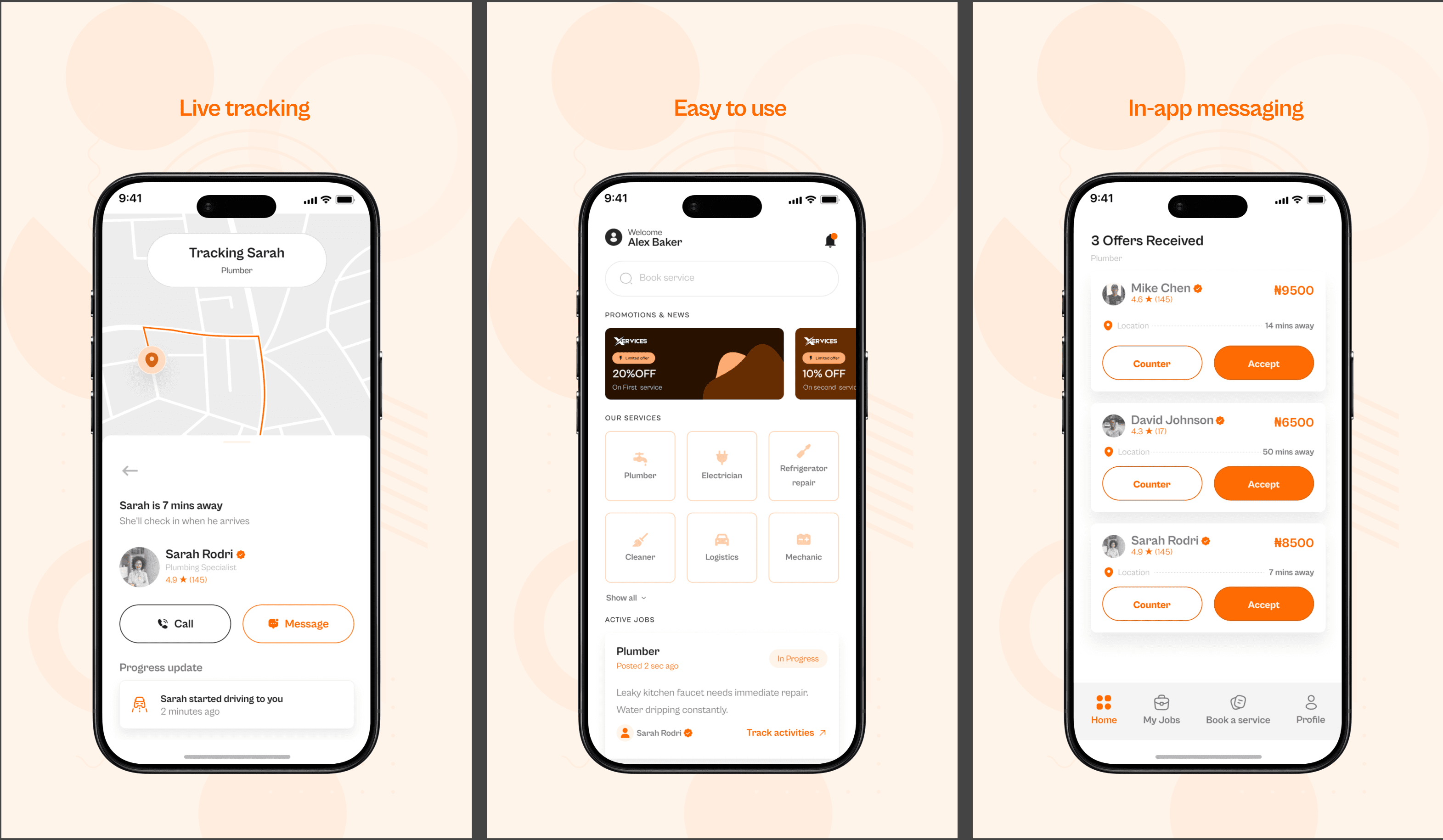
The flows we mapped first were the ones trust actually depends on, not the ones that are easiest to design:
- Live tracking — a customer watching their artisan's real-time location and ETA, with call and message options
- Job bidding — a customer reviewing multiple artisan offers side by side, with the option to counter or accept
- Service discovery — browsing categories like plumbing, electrical, and cleaning, and posting a job in a few taps
The Lean Plan
With four codebases in scope, the lean plan was about sequencing, not cutting:
- 1Ship the backend and customer app first, validating the core booking and matching loop
- 2Bring the professional app online next, enabling real two-sided matching
- 3Layer in the admin console last, once there was real operational data for the ops team to manage
Success Story
Xervices shipped as four coordinated codebases built on one real-time backend: a customer app, a professional app, an admin console, and the API tying them together. The platform now runs live bookings across multiple service categories, with artisans verified against BVN and NIN before they're ever allowed to accept a job.
“They understood that trust was the product, not a feature we could bolt on later.
What impressed me wasn't just that they could build four codebases that actually talked to each other in real time, it's that they never lost sight of why that mattered. Every decision, from how artisan verification worked to how a customer could watch their plumber's ETA update live, came back to the same question: does this make someone trust a stranger with their home? They sequenced the build so we had a working, trustworthy core loop before anything else, and that discipline is the reason we launched with a platform that actually felt ready, not just functional.
David Okonkwo
Founder, Xervices